

+ 38 (097) 036 29 32
content_copy
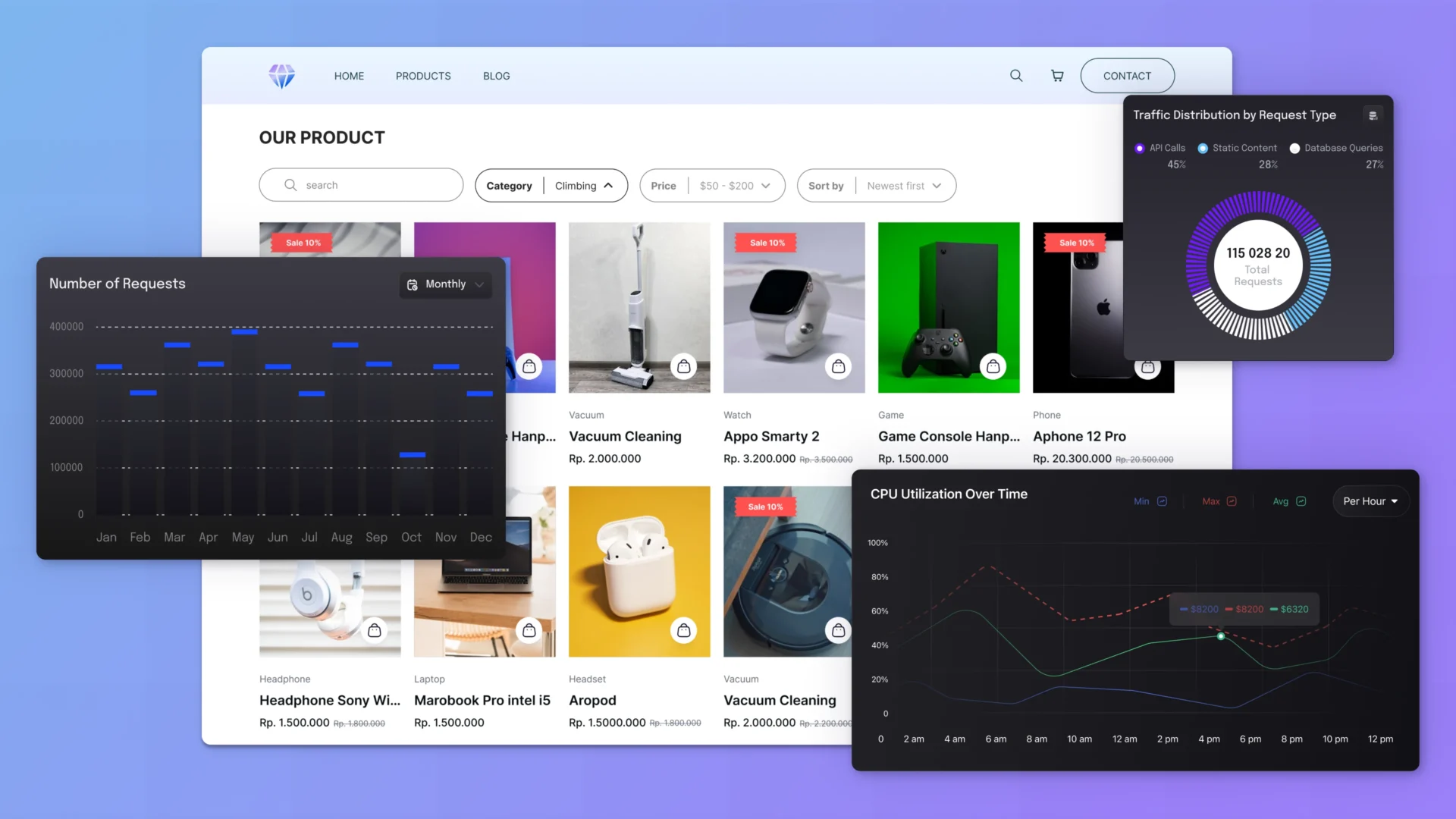
Modern AI tools and approaches like Vibe Coding have radically accelerated the development of digital products. Today, a website, CRM system, admin panel, e-commerce platform, or even a mobile app can be built much faster than just a few years ago. Developers actively use AI assistants, code generation, low-code/no-code approaches, and automation, which allows them to launch an MVP in weeks, and sometimes even in days.
But along with this, a new problem has emerged: the speed of product creation has begun to outpace the quality of architectural design.
Very often, applications created using Vibe Coding work perfectly during the demo phase or with the first few dozen users. However, once they go live, problems arise:
This is precisely why it is especially important to conduct high-load testing after AI-accelerated development. Its purpose is to verify whether the system can handle the actual number of users, requests, and business scenarios.
In load testing, it’s important not just to “load the server,” but to understand the product’s architecture, identify bottlenecks, and anticipate scaling issues in advance.
When an application is built manually by an experienced team that includes a full-fledged architectural design phase, scalability considerations are typically addressed in advance:
At Vibe Coding, the situation is often different. The primary focus is on the speed of developing functionality. As a result, the product may appear ready, but at the same time:
Therefore, load testing becomes a mandatory step before launching any serious product.
This applies especially to:
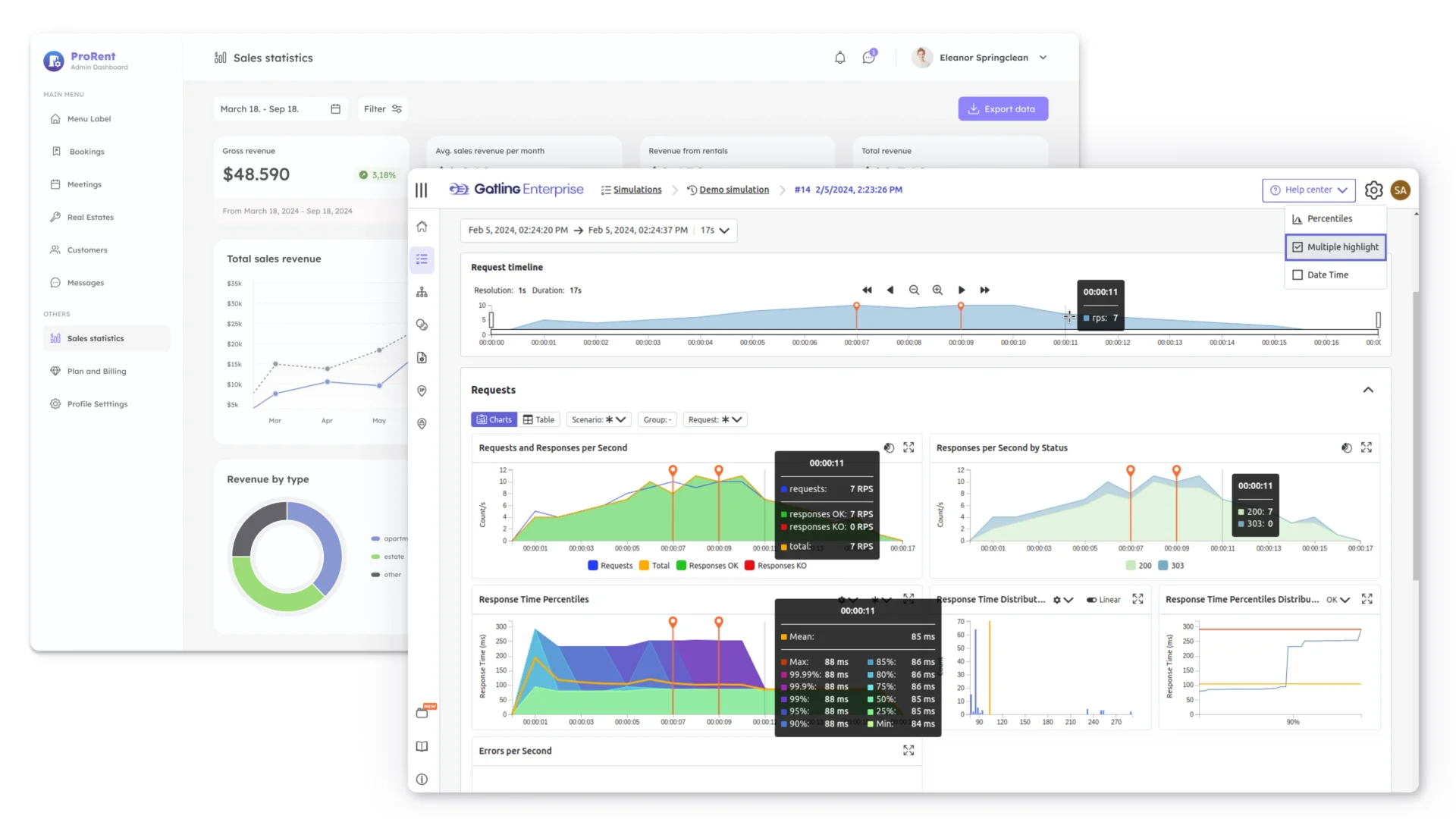
The main goal of load testing is to simulate the behavior of real users and see how the system performs under load.
The following is tested:
Important note: not only the server is tested, but also real-world user scenarios.
For example:
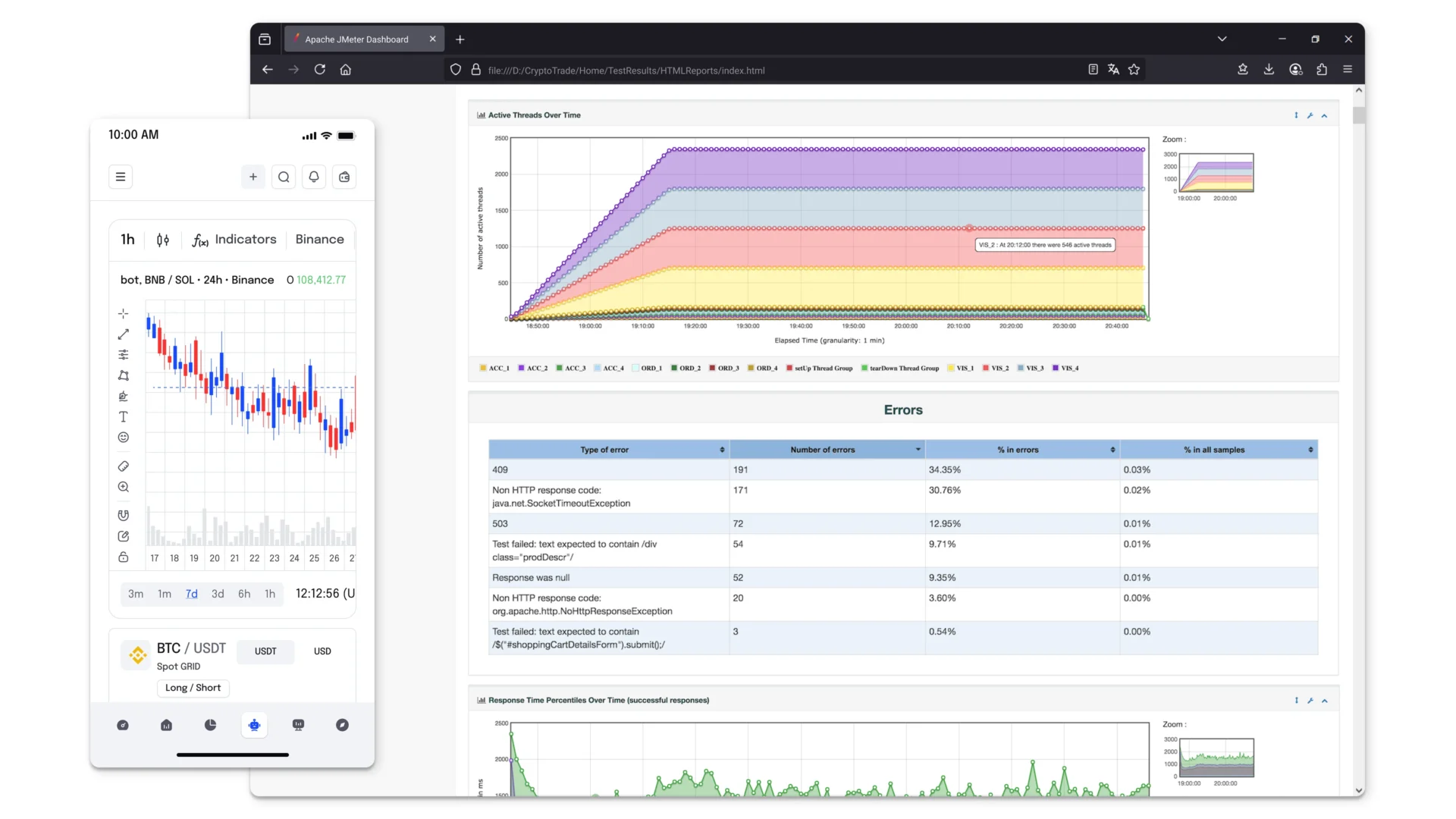
Modern load testing is no longer just about sending a large number of requests to a server; it is a comprehensive system for validating application architecture under real-world load. The diagram shows a typical approach to testing web and mobile systems, where the backend, API, frontend, databases, message queues, and mobile applications are tested simultaneously.
This approach is based on simulating the behavior of real users. To do this, tools such as Locust, Gatling and JMeter are used, which allow for the emulation of user actions: page navigation, interaction with the interface, REST API calls, authentication, order placement, CRM operations, and other user scenarios. Some of these tools work directly with the API, while others record and replay real browser HTTP requests.
Simultaneously with load generation, the monitoring system tracks the status of the server infrastructure. This is typically done using Prometheus and Grafana, which display real-time metrics for CPU, memory, network and database usage, as well as the number of requests, errors, and system response times. This allows us to identify actual architectural bottlenecks and understand which components cannot handle the load.
In addition to load testing, the plan includes functional testing of the API and user interface. To this end, we use JUnit, Pytests, Selenium, Playwright and other automation tools. These tools allow us to verify the correctness of business logic, the stability of the API, and the functionality of the interfaces without the constant manual involvement of testers. This approach is particularly important for complex CRM, SaaS, e-commerce and high-load systems where thousands of users and a large number of integrations operate simultaneously.
The result of the entire testing system is reports, graphs, and analytics, which can be used to determine whether the application is ready for production load, how scalable it is, and which parts of the architecture require optimization before the product is launched into live operation.

Modern load testing typically involves the use of several different sets of tools.
During testing, it is crucial to monitor the infrastructure’s status in real time.
The following tools are used for this purpose:
These tools allow you to monitor:
During load testing, Grafana and Prometheus function as the system’s “dashboard” and help identify actual infrastructure bottlenecks.

Specialized load-testing tools are used to simulate a large number of users.
One of the most popular modern tools. It allows you to write custom scripts in Python and simulate the behavior of thousands of users simultaneously. Suitable for:
Locust is particularly convenient because it allows you to distribute the load across multiple servers and scale testing.

A high-performance load testing tool on the JVM stack. Used for:
Allows you to simulate hundreds and thousands of concurrent users.

One of the most well-known load testing tools. It is particularly useful because it allows you to record user actions via a browser interface:
Once recorded, scenarios can be run in parallel across hundreds of threads, thereby simulating real-world load.

In addition to load testing, it is important to verify the system’s business logic itself.
The following are used for this purpose:
They help test:
User interface automation tools are also used:
These frameworks simulate user actions:
It is important to understand that Selenium and Playwright are more commonly used specifically for UI testing and automation, rather than for full-scale high-load testing.

One of the most common mistakes is simply “bombarding the API with requests.” In practice, real-world load is generated not by random requests, but by user behavior.
That’s why user scenarios are created before testing:
It is precisely these scenarios that provide a realistic picture of the load.
Today, high-load testing is critically important for: CRM and ERP systems, e-commerce platforms and marketplaces, AI platforms, SaaS services, mobile apps, financial services, Telegram Mini Apps, high-traffic websites, gaming platforms, online learning systems, 3D configurators, admin panels.
This is especially important for systems where the following operate simultaneously:
In modern development, load testing can no longer be viewed as a “nice-to-have.” Following the era of Vibe Coding, it has become an essential part of production readiness. AI allows us to build applications faster than ever before. But precisely because of this, there is a growing risk that the product’s architecture will not be ready for real-world use.
Therefore, successful development today involves not only quickly creating an interface or functionality, but also understanding:
Vibe Coding and AI-driven development have dramatically accelerated the creation of digital products. But development speed does not guarantee the system’s reliability under real-world load.
That is precisely why, following AI-accelerated development, it is especially important to conduct comprehensive high-load testing:
Only this approach allows us to determine whether the product is ready for real-world operation and whether it can withstand growth in users, business, and load.
The content of this article is based on a diagram and description of a practical approach to load testing.
Contact the experts Have a question?
Developed by AVADA-MEDIA™
The user, filling out an application on the website https://avada-media.ua/ (hereinafter referred to as the Site), agrees to the terms of this Consent for the processing of personal data (hereinafter referred to as the Consent) in accordance with the Law of Ukraine “On the collection of personal data”. Acceptance of the offer of the Consent is the sending of an application from the Site or an order from the Operator by telephone of the Site.
The user gives his consent to the processing of his personal data with the following conditions:
1. This Consent is given to the processing of personal data both without and using automation tools.
2. Consent applies to the following information: name, phone, email.
3. Consent to the processing of personal data is given in order to provide the User with an answer to the application, further conclude and fulfill obligations under the contracts, provide customer support, inform about services that, in the opinion of the Operator, may be of interest to the User, conduct surveys and market research.
4. The User grants the Operator the right to carry out the following actions (operations) with personal data: collection, recording, systematization, accumulation, storage, clarification (updating, changing), use, depersonalization, blocking, deletion and destruction, transfer to third parties, with the consent of the subject of personal data and compliance with measures to protect personal data from unauthorized access.
5. Personal data is processed by the Operator until all necessary procedures are completed. Also, processing can be stopped at the request of the User by e-mail: info@avada-media.com.ua
6. The User confirms that by giving Consent, he acts freely, by his will and in his interest.
7. This Consent is valid indefinitely until the termination of the processing of personal data for the reasons specified in clause 5 of this document.
Send CV
Contact us in any convenient way for you:
+ 38 (097) 036 29 32